
What toilet height do you actually need?
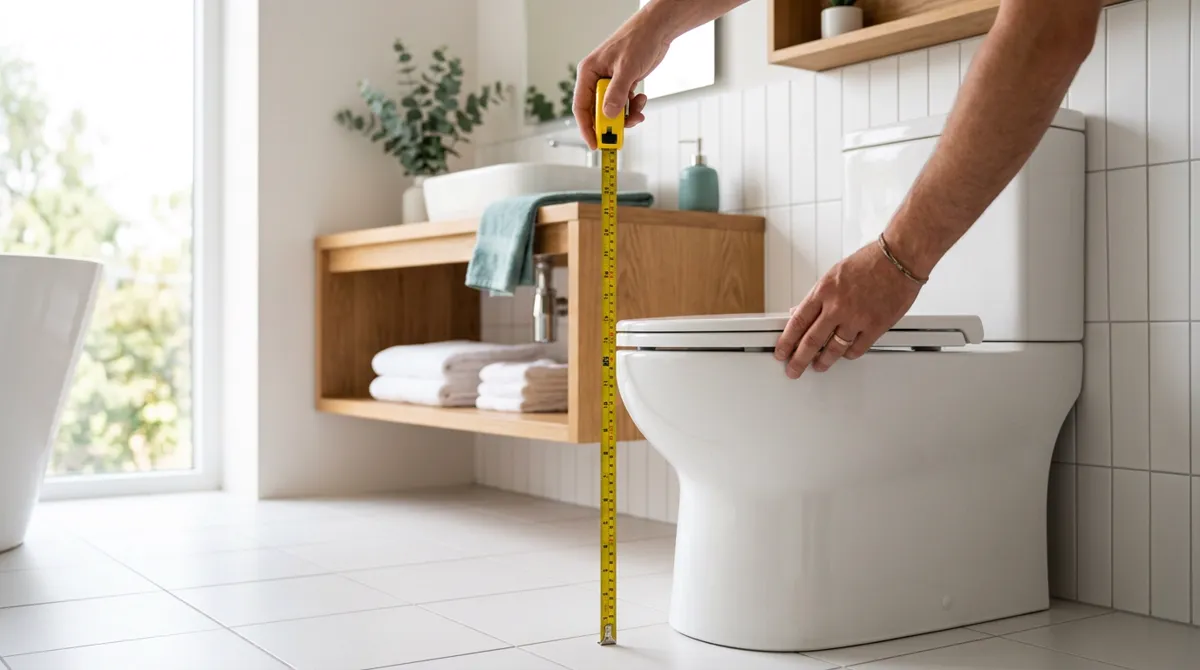
Toilets come in two main heights. Standard height is about 14.5–16 inches from floor to bowl rim (roughly 15–17 inches once the seat is on). Comfort height — also called chair height — is 17–19 inches to the seat top, which is also the ADA-compliant range. Kids' fixtures run about 10–13 inches. Taller users and most people with knee, hip, or mobility issues find chair height easier to stand up from. Shorter users and kids usually do better on standard, because feet flat on the floor matters — for comfort and for bowel mechanics.
Find your toilet height in 20 seconds
1. Who uses this bathroom most?
2. How tall is the main user? (optional)
Check that number. Home toilets run roughly 10 to 20 inches from floor to seat top (a little more with a riser). Make sure you measured in inches, straight up from the floor to the top of the seat.
What you have now: at 13 inches or under, that's a kids-height fixture — normal in preschools, unusual in homes. Any adult using it regularly will want standard height or taller.
What you have now: under about 17 inches to the seat top means a standard-height toilet — the most common setup in US homes.
What you have now: at 17 inches or more to the seat top, you already have a chair-height (comfort height) toilet.
Good news: your toilet is already chair height. If standing up is still hard, a riser can add another 3.5–4 inches — but at that point, solid wall-mounted grab bars usually help more than extra inches. See the raised-seat section below for both.
Our call: you're already set. Your toilet is already in the chair-height range, so there's no need to replace it for height alone. If standing up is still hard, wall-mounted grab bars help more than extra inches — see the raised-seat section for details.
Our call: keep your toilet and add a raised seat. It adds 3.5–4 inches for a fraction of the cost of a new toilet, and installs in minutes. See your answer ↓
Our call: a chair-height (comfort height) toilet — 17–19 inches to the seat top, the ADA range. Easier to stand up from, and the default choice for most adults. See your answer ↓
Our call: standard height is right for this bathroom. Feet flat on the floor beats extra inches here. See your answer ↓
Keep your toilet, raise the seat
If the problem is a senior or anyone with knee, hip, or balance trouble struggling to get up from a standard toilet, you usually don't need a new toilet. A raised toilet seat adds 3.5–4 inches of height, installs without tools in about five minutes, and costs $25–$70 instead of $300-plus for a replacement — plus the plumber. It's also the only real option if you rent.
Vive Raised Toilet Seat Riser with Handles
$55–$70 · 4.5★
Adds 3.5 inches of height plus padded handles to push off of, installs in under five minutes without tools, and hinges up for easy cleaning — ideal after hip or knee surgery.
Fit note: this pick fits standard round bowls only. If your bowl is elongated (oval, longer front to back), go with the Carex below. Not sure which you have? Our toilet seat scanner tells you in seconds.
Check price on Amazon →Carex Toilet Seat Riser with Quick-Lock
$25–$45 · 4.2★
Gives a full 4 inches of lift on both round and elongated bowls for roughly half the price, with a quick-lock tab so it pops on and off in shared bathrooms.
Check price on Amazon →Big John 7-W Classic Toilet Seat
$110–$130 · 4.5★
Rated for 1,200 pounds — the highest capacity available — with the same open-front design and grippy bumpers hospitals and rehab facilities use, and it fits any standard toilet.
Honest note: it's an open-front clinical design with no lid — it won't look like a normal home toilet seat. If that's a dealbreaker, see the alternatives in our bariatric seat guide.
Check price on Amazon →Want more options? See our full guides to the best raised toilet seats and the best bariatric toilet seats.
About grab bars: a raised seat helps most when it's paired with something solid to hold onto. Wall-mounted grab bars from any hardware or medical-supply store — screwed into studs, not drywall anchors — do more for stability than any seat handle. If balance is the main worry, start there. And if mounting them yourself feels iffy, a handyman can do it in an hour; this is one job worth doing right.
Replace with a chair-height toilet
If you're renovating anyway, or you want a permanent fix instead of an add-on, replace the toilet with a chair-height model: 17–19 inches to the seat top, the same range ADA-compliant toilets use. Most major brands sell chair-height versions of their regular toilets at little or no price premium — you don't need a smart toilet to get the height. If you want a smart toilet anyway, these two reviewed models sit in the chair-height range:
TOTO Neorest RH
One-piece smart toilet that TOTO lists as Universal Height and ADA compliant. Its spec sheet puts the top of the seat 17-5/16 inches off the floor, inside the 17–19 inch chair-height range. TOTO's site now shows the RH as discontinued, so check that a seller still has one.
Read our Neorest RH review →Kohler Veil
Sculpted tankless smart toilet in Kohler's Comfort Height — roughly 17 inches to the seat top, meeting ADA height, verified in our review.
Read our Veil review →Browse the best smart toilets →
Before you buy any replacement toilet, measure your rough-in — the wall-to-drain distance that decides which models physically fit. Our toilet rough-in calculator walks you through it in a minute.
Standard height is right for you
If the bathroom mostly serves kids, shorter adults, or a mixed household, keep standard height (14.5–16 inch rim, about 15–17 inches with the seat). Here's why: sitting with your feet flat on the floor — knees level with or slightly above your hips — is more comfortable and puts your body in a better position for bowel movements. On a chair-height toilet, shorter users end up with dangling feet, which works against both.
Standard is also the flexible choice for a shared bathroom. A tall user is mildly inconvenienced by a standard toilet; a short user on a tall toilet loses foot contact entirely. And if one person in the house needs extra height later, a raised seat solves that in five minutes — see the raised-seat section above.
One cheap upgrade worth knowing: a simple footstool in front of the toilet. It gives kids a boost and it lets anyone on a taller toilet get their knees up into that flat-footed, slightly-squatted posture. No special product needed — any sturdy stool from a big-box store works.
How to measure your toilet height
- Measure floor to the top of the seat. That's the number your knees care about. Hold the tape vertical at the front of the bowl and read where the seat's top surface lands.
- Spec sheets often list rim height instead. The bowl rim is the porcelain edge under the seat; the seat adds about an inch. If a product page says "16-inch bowl height," expect roughly 17 inches once the seat is on.
- Read your result: under about 17 inches to the seat top is standard height; 17–19 inches is chair/comfort height (the ADA range); 13 inches or less is a kids' fixture.
- Replacing the toilet? Height is only half the fit question — measure your rough-in too. Replacing just the seat? Check round vs elongated with our toilet seat scanner.
Toilet height comparison: standard vs comfort vs kids
| Type | Height | Who it suits |
|---|---|---|
| Standard height | 14.5–16 in. rim (~15–17 in. with seat) | Kids, shorter adults, mixed households — anyone who wants feet flat on the floor. |
| Comfort / chair height (ADA) | 17–19 in. to seat top | Taller users, seniors, and most people with knee, hip, or mobility issues — easier to stand up from. |
| Kids' fixtures | 10–13 in. | Preschools and dedicated kids' bathrooms. Rare in homes — a footstool on a standard toilet does the same job. |
Comfort height goes by different brand names — Universal Height (TOTO), Comfort Height (Kohler), Right Height (American Standard) — but they all land in the same 17–19 inch ADA range.
Sources
The 17–19 inch seat-height range on this page is the ADA’s: the 2010 ADA Standards for Accessible Design (section 604.4) set an accessible toilet’s seat height at 17 inches minimum and 19 inches maximum above the floor, measured to the top of the seat.
Frequently asked questions
What is a comfort height toilet exactly?
A comfort height toilet puts the seat 17 to 19 inches off the floor, versus roughly 15 to 17 inches (with the seat) on a standard toilet. Brands use different names for the same thing — Chair Height (TOTO), Comfort Height (Kohler), Right Height (American Standard) — but they all land in that 17–19 inch range. The extra 2 inches or so makes sitting down and standing up noticeably easier, especially for taller people and anyone with knee or hip trouble.
Is comfort height the same as ADA height?
For the seat height itself, yes — the ADA requires 17 to 19 inches from floor to seat top, and comfort/chair height toilets fall in exactly that range. Full ADA compliance in a public restroom also involves grab bars, clearances, and flush-control placement, so a comfort height toilet alone doesn't make a bathroom 'ADA compliant.' For a home, though, the height range is the part that matters.
Are taller toilets bad for constipation?
They can work against you if your feet don't reach the floor. A slightly squatted posture — knees at or above hip level, feet planted — helps some people pass stool more easily, and mainstream advice from GI doctors backs that up. On a tall toilet, shorter users lose that position. The fix is cheap: a footstool under your feet restores the posture on any toilet height. So if standing up is your bigger problem, get the taller toilet and add a footstool.
Can I make my toilet taller without replacing it?
Yes. A raised toilet seat adds 3.5 to 4 inches, installs without tools in about five minutes, and costs $25 to $70 — versus several hundred dollars plus install for a new chair-height toilet. It's the standard fix after hip or knee surgery and the only practical option for renters. See our best raised toilet seats guide for current picks, including handles-equipped and bariatric versions.
What toilet height is best for elderly parents?
Aim for 17 to 19 inches to the seat top — the chair-height/ADA range — because it takes far less knee and hip strength to stand up from. If their current toilet is standard height, the cheapest fix is a raised seat with handles plus wall-mounted grab bars screwed into studs; together they cost well under $150. If you're renovating anyway, install a chair-height toilet so nothing has to be added on later.
How tall is a standard toilet?
A standard toilet bowl is about 14.5 to 16 inches from the floor to the rim, and the seat adds roughly an inch — so figure 15 to 17 inches to the seat top. That's what most US homes have. If you measure yours and get 17 inches or more to the seat top, you already have a chair-height (comfort height) toilet.