
Toilet Rough-In Calculator
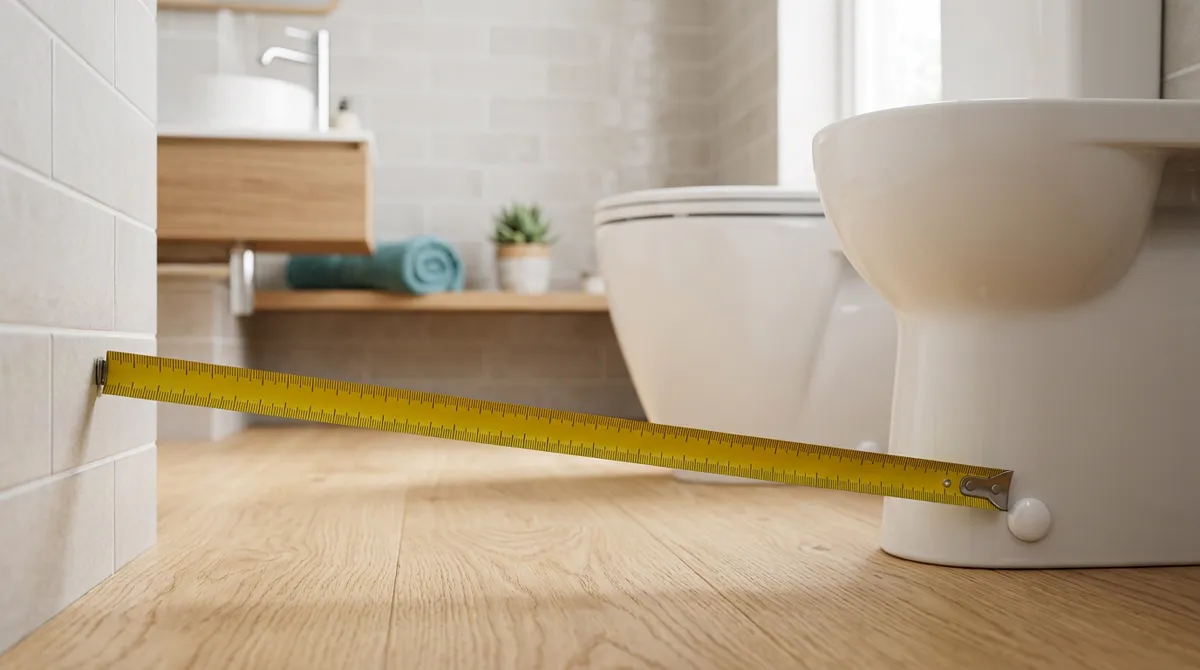
Rough-in is the distance from the finished wall behind the toilet to the center of the closet-bolt caps — the little domes at the base where the toilet bolts to the floor. Measure that one number and you know whether you need a 10-inch, 12-inch, or 14-inch toilet.
How to measure your rough-in (3 steps)
- Start at the finished wall, not the baseboard. Hold the end of your tape flat against the wall behind the toilet, above the baseboard. Measuring off the baseboard is the number-one mistake — it shorts the number by half an inch or more.
- Measure to the center of the bolt caps. Those are the two small domes at the base of the toilet, one on each side. Run the tape to the middle of a cap — not its front or back edge.
- Skirted toilet or thick baseboard? If a skirt hides the bolt caps, measure to the center of where the toilet body meets the floor at the bolts, or look up the old toilet's spec sheet. If you can only measure from a thick baseboard, add its thickness back to your number.
Enter your measurement
Type your number and your size appears instantly.
Check that number.
You're between standard sizes. Closest standard size: 12-inch. Before you trust that, re-measure — did you measure from the baseboard instead of the wall? Did you stop at the front edge of the bolt cap instead of its center? Small errors like those land you between sizes.
Your rough-in: 12 inches — the standard. Nearly every toilet sold in the US is built for a 12-inch rough-in, including the one-piece smart toilets we've reviewed. You can shop without worrying about fit — just skim the spec sheet to confirm, out of habit.
TOTO Neorest RH
One-piece smart toilet with a standard 12-inch rough-in — verified in our review. TOTO now marks it discontinued, so confirm stock first.
Read our Neorest RH review →Kohler Veil
Sculpted tankless one-piece smart toilet with a standard 12-inch rough-in — verified in our review.
Read our Veil review →Your rough-in: 10 inches. That's a real standard size, but fewer models are made for it. Always confirm the spec sheet lists a 10-inch rough-in before you buy — don't assume. Some brands also sell adapter or Unifit-style kits that let certain 12-inch models fit a 10-inch rough-in; check the listing.
Start with our best smart toilets guide and verify the 10-inch spec on anything you shortlist. Only replacing the seat? Rough-in doesn't matter for that — here's how to measure a toilet seat instead.
Your rough-in: 14 inches. That's the rarest of the three standard sizes, so your model list is shorter. Always confirm the spec sheet lists a 14-inch rough-in before you buy — don't assume. Some brands sell adapter kits that let certain 12-inch models fit a 14-inch rough-in; check the listing (you may also just get a bigger gap behind the tank).
Start with our best smart toilets guide and verify the 14-inch spec on anything you shortlist. Only replacing the seat? Rough-in doesn't matter for that — here's how to measure a toilet seat instead.
Standard toilet dimensions (quick reference)
| Measurement | Typical range | Notes |
|---|---|---|
| Rough-in | 10, 12, or 14 in. | 12 in. is the standard. Measure wall to bolt-cap center. |
| Overall depth | ~27–30 in. | Wall to the front tip of the bowl. |
| Overall width | ~14–15.5 in. | Widest point — usually the tank or the seat. |
| Standard bowl height | ~15–16 in. | Floor to rim; the seat adds about an inch. |
| Chair / ADA height | ~17–19 in. | Easier to stand up from; the range ADA-compliant toilets use. |
| Side clearance | 15 in. minimum | From the bowl's centerline to any wall, vanity, or fixture. |
| Front clearance | 21–24 in. | Open floor space in front of the bowl. |
Clearance figures are common US code minimums, but building codes vary by state and city — check your local code before you move a wall or plumbing.
Frequently asked questions
What is a toilet rough-in?
The rough-in is the distance from the finished wall behind the toilet to the center of the drain pipe. In practice you measure from the wall to the center of the closet-bolt caps at the toilet's base, since the bolts line up with the drain. It decides which toilets physically fit: most are built for a 12-inch rough-in, with fewer 10-inch and 14-inch models.
What if my measurement is 11.25 inches?
Nine times out of ten that's a 12-inch rough-in measured wrong. Re-measure from the finished wall (not the baseboard) and stop at the center of the bolt cap (not its front edge) — each of those mistakes shaves off roughly half an inch to an inch. If it truly is around 11.25 inches, note that some 12-inch toilets list a minimum rough-in of 11 to 11.5 inches on the spec sheet — check before you buy. A 10-inch model will also fit, with a small gap behind the tank.
Are all toilets 12-inch rough-in?
No, but most are. Twelve inches is the standard, and the large majority of toilets sold in the US are built for it. Ten-inch models show up in older homes and tight bathrooms, and 14-inch models exist but are the rarest. If your rough-in is 10 or 14 inches, filter for that spec before you fall in love with a model.
Do skirted toilets measure differently?
The rough-in itself is the same — wall to drain center. But a skirted toilet hides its bolt caps behind the smooth skirt, so you often can't see them. Measure to the center of where the toilet body meets the floor at its rear mounting point, or look up the old toilet's spec sheet for its listed rough-in. If the toilet is already removed, just measure from the wall to the center of the drain flange in the floor.
Can I replace a 10-inch rough-in toilet with a 12-inch toilet?
Not as a straight swap — on a 10-inch rough-in, a 12-inch toilet's tank usually hits the wall before the bolts line up. Offset flanges and brand adapter kits (like TOTO's Unifit) exist and can make it work, but moving or offsetting the flange is a real plumbing job, not a five-minute swap. The reverse is easy: a 10-inch toilet on a 12-inch rough-in bolts right in, it just leaves about a 2-inch gap behind the tank.
How do I measure rough-in if the toilet is already removed?
Easiest case of all. Measure from the finished wall straight to the center of the drain flange (the ring in the floor the toilet bolts to). That number is your rough-in — round to the nearest standard size: 10, 12, or 14 inches.