
How to measure a toilet seat
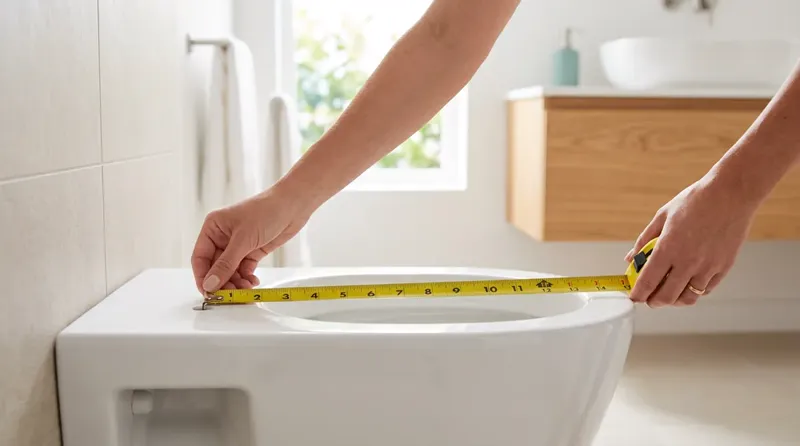
Buying a replacement toilet seat without measuring first is one of the most common bathroom mistakes. Seats come in two standard shapes — round and elongated — and even though the bolt holes are almost always the same distance apart, the bowl length and width vary enough that a wrong-shape seat will either hang over the bowl or leave a gap at the front. Taking three measurements before you shop saves a trip back to the store.
The good news is that measuring a toilet seat takes about five minutes and requires nothing more than a tape measure and a notepad. The key numbers are: the distance from the bolt holes to the front of the bowl (which tells you the shape), the spread between the two bolt holes (which confirms the seat will mount correctly), and the width at the widest point of the bowl. Get those three numbers right and you can shop with confidence — in person or online.
This guide walks you through each measurement in plain language, explains what the numbers mean, and shows you how to double-check your bowl shape using the toilet's model number if the tape measure leaves you unsure. We also flag a few things to watch out for, including older and European toilets that occasionally fall outside standard dimensions.
Got your measurements? See our top toilet seats.
See our picks →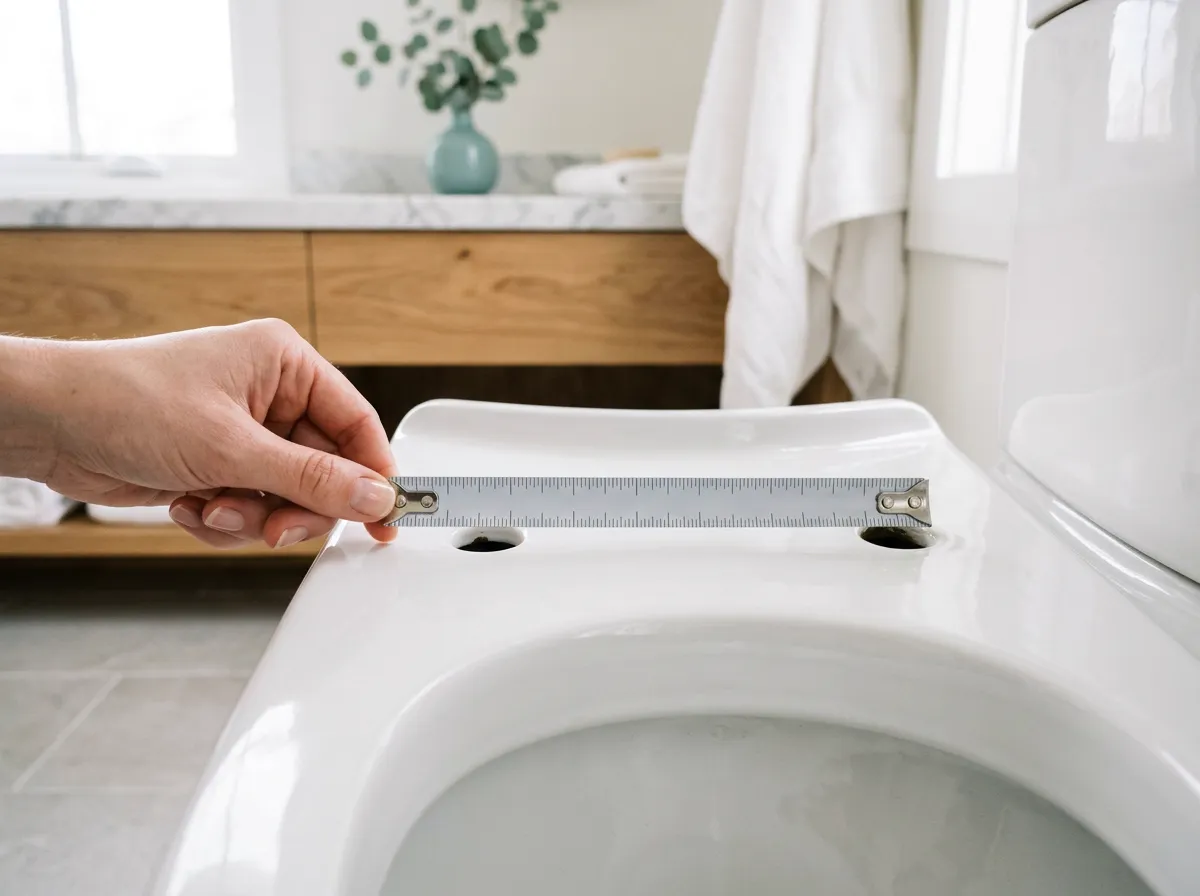
What you'll need
- Tape measure (at least 24 inches long)
- Pencil or pen
- Notepad or your phone to record measurements
- Flashlight or phone light (helpful for reading the model number inside the tank)
Step by step
- Lift the existing seat and lid out of the way. Raise the toilet seat and lid and prop them back or temporarily remove the seat if it is in the way. You need a clear, unobstructed view of the entire bowl rim from the bolt holes at the back to the front edge. Wipe the rim dry if needed so your tape measure lies flat and gives an accurate reading.
- Find and note the bolt holes. Look at the back of the bowl, near where the seat hinges sit. You will see two mounting holes set into the porcelain, one on the left and one on the right. These are where the seat bolts pass through. All your measurements start from these holes, so take a moment to locate their centers clearly before measuring.
- Measure bolt-hole spread (left center to right center). Stretch your tape measure from the center of the left bolt hole to the center of the right bolt hole. In the United States the standard spread is 5.5 inches (about 14 cm), and the vast majority of American toilets made in the last 40 years match this exactly. Write this number down. If your measurement is 6 to 6.5 inches you likely have a European or older domestic toilet and will need to look for a seat that specifies that spread.
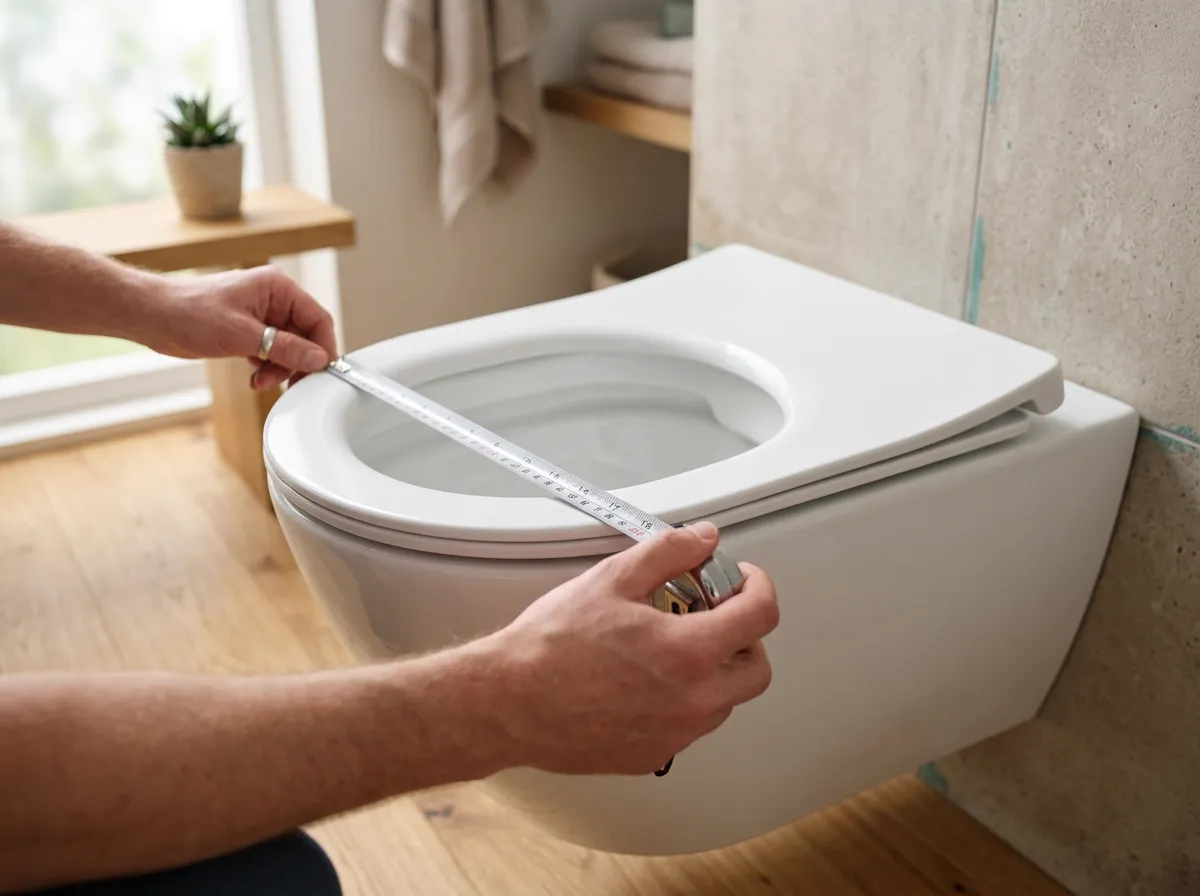
- Measure bowl length (bolt holes to front lip) — this determines the shape. This is the most important measurement. Place the end of your tape measure at the center point between the two bolt holes — not at the edge of the porcelain, but at the midpoint between the two hole centers. Run the tape straight forward to the very front outer edge of the bowl rim. A measurement of approximately 16.5 inches indicates a round bowl. A measurement of approximately 18.5 inches indicates an elongated bowl. Measurements that fall within about half an inch of either number are normal; if you land between 17 and 18 inches, double-check by looking up the model number (see Step 6).
- Measure bowl width at the widest point. Run your tape measure across the widest part of the bowl rim, which is usually about two-thirds of the way toward the front. Most standard American bowls measure between 14 and 14.5 inches wide. This measurement primarily helps you confirm the seat you choose will cover the rim properly and will not look undersized. Some compact or designer toilets fall outside this range, so record the number rather than assuming.
- Look up the model number to confirm bowl shape. If your length measurement is borderline, or you simply want a second confirmation, find your toilet's model number. Remove the tank lid and look on the underside of the lid or on the back wall inside the tank — model numbers are typically stamped or printed there, often in raised porcelain lettering. Write down the full number (example: K-3999 for a Kohler, or 2034.014 for an American Standard). Then search the manufacturer's website or enter the model number plus 'bowl shape' into a search engine. Manufacturer specification pages list the bowl shape explicitly and will confirm whether you have a round or elongated toilet.
- Compare your three numbers to seat specifications before buying. Every seat listing — whether on a store shelf or a product page — should state the bowl shape it fits (round or elongated) and the bolt spread it requires. Match your three measurements: shape confirmed by bowl length, bolt spread (standard 5.5 inches or non-standard), and bowl width. If a seat lists only 'round' or 'elongated' without further dimensions, it is almost certainly built for the 5.5-inch standard spread. For bidet seats and soft-close seats, also check the seat's own width and hinge-to-front measurement, which manufacturers publish, to make sure it will not overhang your specific bowl.
Tips & warnings
- Do not force the bolt nuts tight against porcelain. When installing the new seat, tighten the mounting nuts until the seat is firm and does not shift — then stop. Over-tightening cracks the porcelain around the bolt holes, which is an expensive repair.
- Elongated seats are more common than you might expect even in older homes. If you have been living with a round seat on an elongated bowl (or vice versa), the swap to the correct shape makes a noticeable comfort difference.
- If your bolt-hole spread measures 6 to 6.5 inches, you have a non-standard toilet (common in older American homes and most European imports). A standard replacement seat will not fit correctly — search specifically for 'wide spread' or 'European spread' toilet seats.
- Measure twice before ordering online. Seat returns are possible but inconvenient. A 30-second second pass with the tape measure is worth it.
- Compact elongated bowls exist — they measure around 17 to 17.5 inches and are designed to fit in smaller bathrooms. Seats for these are labeled 'compact elongated' and are not interchangeable with standard elongated (18.5 inch) seats.
Frequently asked questions
What is the difference between a round and elongated toilet seat?
Round seats fit bowls that measure approximately 16.5 inches from the bolt holes to the front lip. Elongated seats fit bowls that measure approximately 18.5 inches. Elongated bowls are generally considered more comfortable for adults because of the added front-to-back length. The two shapes are not interchangeable — a round seat on an elongated bowl leaves a gap at the front, and an elongated seat on a round bowl overhangs the front of the bowl.
Can I install an elongated seat on a round toilet?
No, not correctly. An elongated seat is about two inches longer than a round bowl. The seat will extend past the front of the bowl, leaving an unsupported overhang that shifts under weight and looks wrong. Always match the seat shape to the bowl shape you measured.
Are all toilet bolt holes the same distance apart?
In North America, yes — almost universally. The standard bolt-hole spread is 5.5 inches (center to center), and this applies to the vast majority of toilets made for the U.S. market. Exceptions include some toilets manufactured in Europe, certain older American models, and a small number of specialty designs, which may measure 6 to 6.5 inches. Measure yours to be sure before buying.
How do I find my toilet's model number?
Remove the tank lid and look on the underside of the lid or on the inside back wall of the tank. Model numbers are usually stamped directly into the porcelain or printed on a label. Common locations include the back inner wall of the tank, the bottom of the tank lid, or occasionally on the bowl itself near the floor. Once you have the number, search the manufacturer's website to pull up the full spec sheet, which will list the bowl shape.
My measurement came out to about 17 inches — is that round or elongated?
A measurement between roughly 17 and 18 inches puts you in an uncertain zone. This can happen with compact elongated bowls (designed for smaller bathrooms and typically labeled 'compact elongated' at around 17 to 17.5 inches) or simply from slight measurement variation. Look up the toilet model number as described in Step 6 to get the manufacturer's confirmed bowl shape — that will be more reliable than a borderline tape measure reading.
Do I need to measure if I am replacing the seat with the same brand?
It is still worth confirming. Toilet manufacturers sometimes change bowl dimensions between product generations, and a seat number that matches an older toilet may not be an exact fit for a newer one with the same brand name. If you know the specific seat model number from your original toilet's documentation, you can order that exact replacement. Otherwise, take the three measurements to verify compatibility before ordering.